
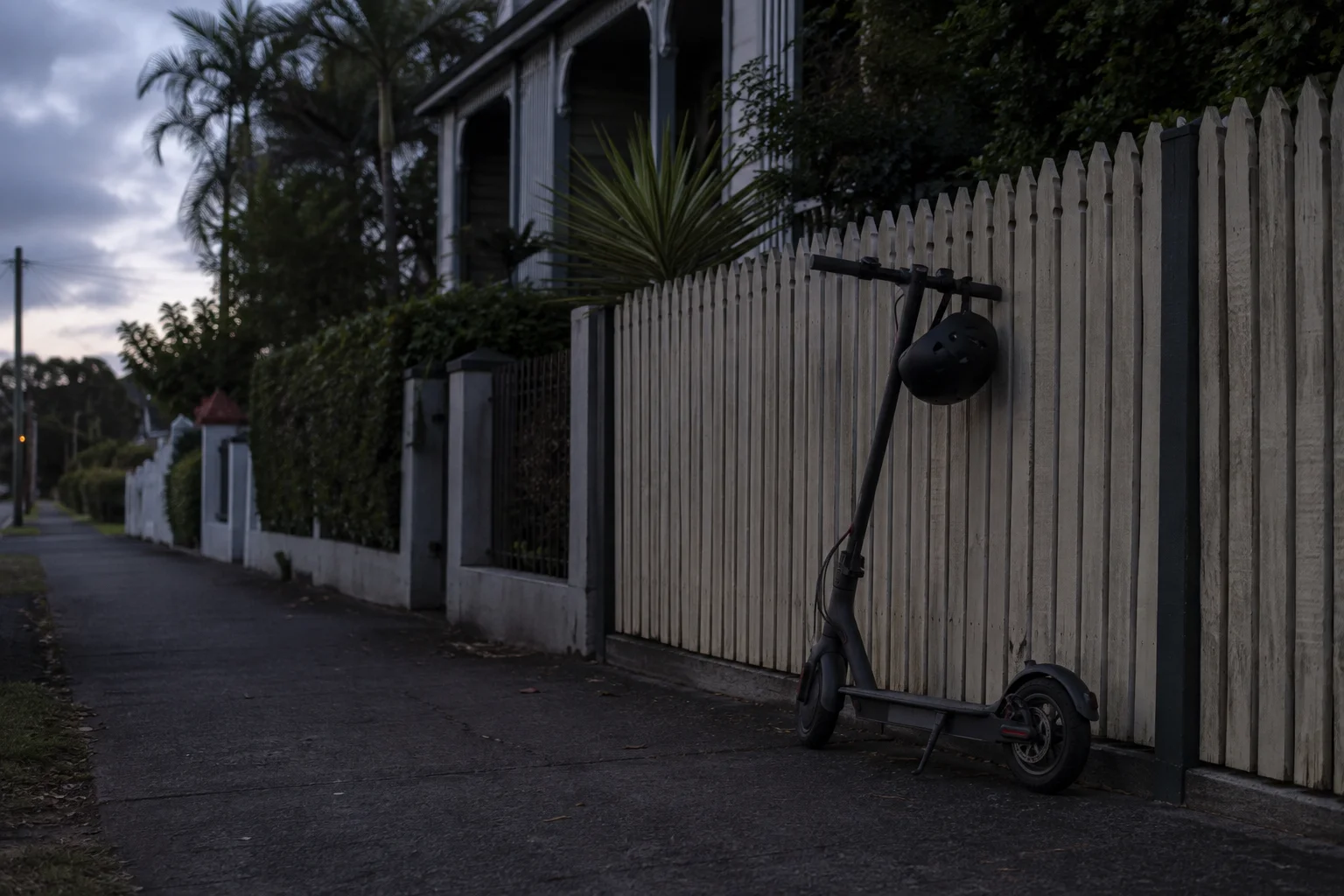
From 31 August 2026, you must be at least 16 years old and hold a valid driver licence (including a learner, interstate or overseas licence) to ride an e-scooter, e-bike, e-skateboard or e-unicycle on Queensland roads and paths. The offence provision is in the new section 78B of the Transport Operations (Road Use Management) Act 1995 (Qld), inserted by the Transport and Other Legislation (Managing E-mobility Use and Protecting Our Communities) Amendment Act 2026. Riding unlicensed or underage attracts a $518 on-the-spot fine, with a court able to impose up to 30 penalty units ($5,181), and parents can be fined for a child who rides illegally, as at 31 August 2026.
What changed on 31 August 2026?
The licensing rules are the second stage of Queensland’s e-mobility reforms. Since 1 July 2026, devices capable of travelling more than 25km/h under motor power have been banned outright. Police are able to seize and destroy illegal devices, and retailers have been prohibited from selling e-mobility devices to anyone under 16.
From 31 August 2026, every rider on a road, footpath, bike path or shared path must:
- be at least 16 years old, and
- hold a valid driver licence. Queensland learner, provisional, probationary and open licences are all acceptable, as well as interstate and overseas licences.
The rules cover e-scooters, e-skateboards, e-unicycles and other personal mobility devices, as well as e-bikes, including ordinary pedal-assist bicycles (EPACs). A conventional, unpowered bicycle is not affected.
Who can still ride without a licence?
There are three exceptions, set out on the Queensland Government’s e-mobility licensing pages:
- Supervised riders aged 12 to 17. The supervising adult must be the rider’s parent, grandparent or legal guardian (or another responsible adult prescribed by regulation) and close enough to give the rider instructions. This also covers 16 and 17 year olds who have not yet obtained a learner licence. There is no supervised-riding exception for children under 12.
- Designated recreational areas. Children and unlicensed riders can still ride in places like rail trails, mountain-bike trails and private off-road facilities. The Government publishes a list of approved riding areas.
- Medical exemptions. A person 16 or older who cannot get a driver licence because of a medical condition or disability can apply for an exemption using form F5464. A registered health practitioner must certify that the person can ride safely, and can attach conditions, for example riding only in daylight or only under supervision. An exemption can last up to 5 years. A grace period runs until 30 November 2026 for eligible riders to get their paperwork in order; after that the exemption must be held to ride.
What if your licence is suspended or disqualified?
This is the change most likely to catch people out. A valid licence is defined as one that has not expired, has not been cancelled or suspended, and whose holder is not disqualified from holding or obtaining a driver licence in Queensland or any other jurisdiction. A medical exemption is also unavailable where a licence was suspended, disqualified or cancelled for non-medical reasons. So from 31 August 2026, a person whose licence is suspended (including a demerit-point or SPER suspension) or who is disqualified cannot lawfully ride an e-scooter or e-bike, with the offence itself carrying a fine of up to 30 penalty units ($5,181) in court.
Before these reforms, an e-scooter or e-bike was a common way to get to work during a disqualification. That option is now gone. If losing your licence would cost you your job, you either need to ride a conventional push bike, or apply for a work licence or special hardship order to keep you on the road lawfully.
Do the road rules apply to e-scooters and e-bikes?
Yes. Under Queensland transport law an e-scooter is a personal mobility device and a pedal-assist e-bike is an electrically power-assisted cycle, and riders of both are treated as vehicle users, not pedestrians. The Queensland Road Rules govern how and where you ride (the footpath and shared-path speed limits, helmet and passenger rules, and giving way), and the offence provisions of the Transport Operations (Road Use Management) Act 1995 apply to riders too: careless riding, mobile phone use, failing to stop and exchange details after a crash, and the drink and drug offences covered below.
The important structural point is that these devices are expressly excluded from the definition of a motor vehicle. Most riding offences are dealt with by fine rather than imprisonment, and, as explained below, the automatic licence consequences that attach to motor vehicle offences do not attach to riding offences.
What are the fines?
Queensland Police enforce the rules with on-the-spot fines. The main amounts, as at 31 August 2026, per Transport and Main Roads:
| Offence | Fine |
|---|---|
| Riding underage (under 16) | $518 |
| Riding without a valid licence | $518 |
| No helmet, or helmet not fastened | $518 |
| Carrying a passenger | $518 |
| Careless riding | $518 |
| Riding on a road where devices are prohibited | $518 |
| Speeding on a footpath (12km/h limit) | $345 to $1,986, depending on speed |
| Using a mobile phone while riding | $1,295 |
| Unsafe parking | $172 |
| Parent liability for a child riding illegally | $518 |
| Drink riding | $518, up to a court-imposed maximum of $6,908 |
Those are on-the-spot amounts; the maximum penalties that can be applied if the matter is taken to court are higher (riding unlicensed or underage, for example, carries up to 30 penalty units, $5,181). A fine is the usual outcome, but more serious matters, for example drink riding at a high reading or a crash causing injury, can end up in court. If you receive a notice to appear rather than a ticket, read about what happens at a first court date and get advice before you go.
Can you be fined for your child’s use of an e-scooter?
Yes. Under new section 78D of the Act, where a child under 16 commits one of these riding offences, a parent is taken to have also committed the same offence and is liable to the same penalty. There are two defences: that the parent did not know and could not reasonably have been expected to know of the child’s riding, or that the parent took all reasonable steps to prevent it. The on-the-spot parental fine is $518.
Retailers have been banned from selling e-mobility devices to under 16s since 1 July 2026, and police can seize a non-compliant device regardless of who owns it.
Outside designated recreational areas, the only exception is the supervised-riding exception, which allows a 12 to 17 year old to ride an e-scooter while a parent or caregiver supervises close enough to give instructions. Failing to supervise as required means the parent is liable for their child’s actions in riding an e-scooter unlawfully.
Can you be charged with “drink riding” on an e-scooter?
Yes. Since 1 July 2026, drink riding has been written directly into section 79 of the Transport Operations (Road Use Management) Act 1995, the same section that houses drink driving. Police can require a breath specimen from an e-scooter or e-bike rider under section 80, and refusing a breath test is treated as the most serious riding offence, riding under the influence. The offences and their maximum penalties as at 31 August 2026 (penalty unit value $172.70) are:
| Reading | Provision | Maximum penalty |
|---|---|---|
| 0.05 to under 0.10 | s 79(2AAB) | 20 penalty units ($3,454), fine only |
| 0.10 to under 0.15 | s 79(2AAA) | 28 penalty units ($4,835.60), fine only |
| Riding under the influence (a reading of 0.15 or more is conclusive proof) | s 79(7A) | 40 penalty units ($6,908) or 9 months’ imprisonment |
The $518 figure Transport and Main Roads publishes is the on-the-spot fine; the above table shows what a court can impose. Enforcement is real rather than theoretical: in the first two months of the new device rules, Queensland Police reported roughly 1,750 fines, about 400 devices seized, and 54 riders facing drink-riding charges.
Will drink riding cost you your driver licence?
Drink riding offences do not carry the automatic licence consequences that drink driving in a car does. The immediate suspension on charge (section 79B) and the automatic disqualification on conviction (section 86) are both confined to motor vehicle offences, and the Act’s definition of a motor vehicle excludes personal mobility devices and power-assisted cycles.
Also, the usual drug driving offences, where it is an offence to drive with THC or another relevant drug merely present in your saliva, apply to motor vehicles only. A rider commits a drug offence only when riding under the influence of the drug.
However, that is no reason to treat a charge lightly. If you have been charged after riding with alcohol or drugs in your system, the offence falls in the same category we cover in our drink and drug driving practice, and the early steps matter just as much.
Can police seize your e-bike?
Yes. Since 1 July 2026, police can seize and destroy illegal devices, meaning devices whose motor can propel them faster than 25km/h. E-scooters, e-skateboards and e-unicycles bought before 1 July 2026 that exceed the limit must be retrofitted to cap motor output by 28 February 2027, and compliance labelling for e-bikes becomes mandatory on the same date. An e-bike whose motor assists beyond 25km/h is not a bicycle in the eyes of the law; it is an unregistrable motorbike, and riding one on the road exposes you to seizure and to more serious charges.
What about hire scooters?
The way the rules are worded means hire scooters and hire bikes are also covered. You need to be 16 and licensed in order to ride a Lime or Neuron device, the same as your own. Hire operators have until March 2027 to build age and licence verification into their sign-up processes, but the obligation on the rider does not wait for the apps to catch up.
What should you do if you are fined or charged?
For a single on-the-spot fine, paying it is often the end of the matter, but a fine is still an admission with a record attached, and fines can accumulate quickly under these rules. Where a matter involves alcohol or drugs, a crash, an injured pedestrian, a seized device or a rider who is disqualified from driving, the stakes are higher and the right response depends on the facts.
If you or your child has been charged over an e-scooter or e-bike, or you are disqualified and unsure what transport options remain open to you, contact us for confidential advice. We are available 24/7 for urgent matters.
This article is general legal information, not advice about your situation.
Worried about what happens next?
Speak confidentially with an experienced criminal defence lawyer. No judgement, no obligation. Available 24/7 for urgent matters.